

In today’s fast-paced digital landscape, businesses are always looking for ways to streamline data management to enhance efficiency and drive innovation. The Relyence API offers a powerful solution for developers and organizations to simplify their workflows, automate processes, and seamlessly integrate data across multiple platforms. By utilizing the Relyence API, companies can build new applications, enhance existing systems, and optimize workflows, all while improving overall productivity.
In this comprehensive guide, we will explore key features of the Relyence API, discuss its benefits, and highlight practical use cases to help you get started.
What is an API?
An Application Programming Interface (API) is a powerful set of rules and protocols that facilitate communication and data transfer between software components. By defining how requests and responses are structured, APIs enable smooth integration across different systems and applications. Essentially, an API acts as a bridge that allows different software applications to communicate and share data.
One of the standout benefits of utilizing an API is the ability to customize your data flow within your workflow. The Relyence API empowers users to easily import and export data across the Relyence products, allowing for seamless connections to other tools used in your organization. This flexibility enhances efficiency and streamlines operations, making it easier to manage your projects.

What Can I Do with the Relyence API?
Every organization has unique requirements and the Relyence API is designed to be adaptable and offers diverse ways to enhance operational efficiency and drive success. By integrating the Relyence API into your workflow, your organization can unlock numerous benefits tailored to your specific needs. Here are some common use cases for the Relyence API.
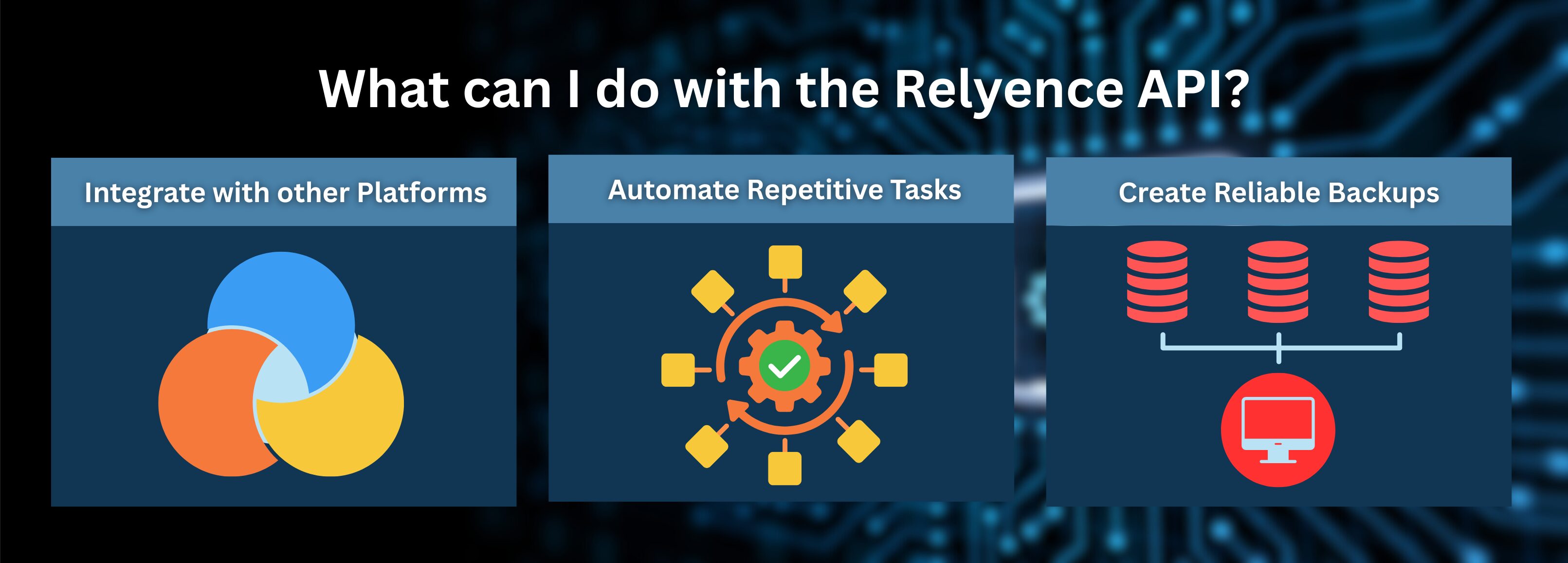
Integrating with Other Platforms
Many businesses use multiple software tools, and integration is key to keeping everything connected. The Relyence API makes it easy to sync data between Relyence and other platforms. This functionality enables organizations to integrate Relyence seamlessly into their data workflows.
For example, if a business employs an external tool to automatically track incidents, those reports can be imported into FRACAS via the Relyence API. Similarly, if your organization utilizes an external system to monitor progress on your FMEA, you can easily retrieve the most current versions to ensure that all progress benchmarks are met.
Automating Repetitive Tasks
Manually transferring data between systems can be time-consuming and prone to errors. By leveraging the Relyence API, you can automate the process of importing and exporting data between Relyence and various software applications, including Customer Relationship Management (CRM) and Enterprise Resource Planning (ERP) platforms. Furthermore, you can establish automated scripts to periodically fetch or send data to and from Relyence, ensuring that all your software solutions are updated with the most current information. This automation enhances data accuracy and streamlines workflows across your organization.
Creating Reliable Backups
Data protection is a top priority for any organization. With the Relyence API, organizations can automatically pull information from specific Analyses, providing an effective method for creating backups. In the event of data loss or unintentional changes, these backups enable users to easily restore previous versions of their data, ensuring data integrity and minimizing disruptions. By utilizing the Relyence API for automated data backup, organizations can enhance their data management strategies and safeguard critical information.
What are the Benefits of Using the Relyence API?
The Relyence API offers a suite of features designed to optimize operations across your organization. From automating data entry and streamlining reporting processes to facilitating easier scaling and providing increased flexibility, the Relyence API empowers teams to focus on what matters most—delivering value and driving innovation.
Time and Cost Effectiveness
Utilizing the Relyence API can automate data synchronization, eliminating the need for manual data input between systems. This saves time and reduces the likelihood of human error. Additionally, using the Relyence API can facilitate automated data extraction and reporting, minimizing the need to gather and compile reports manually and allowing teams to quickly access insights.
Scaling with Ease
As your organization grows, so does your data. Managing multiple Analyses can be overwhelming, but the Relyence API helps you synchronize and integrate data between various Analyses. This can help create a unified view of your data, making it easier to analyze and use. Additionally, as your data needs grow, you can easily add new data sources or endpoints using your API integration without significant changes to your existing infrastructure.
Maximizing Flexibility
Every business operates differently, and the Relyence API allows you to customize your processes to meet your specific goals. Users can develop custom data workflows using the Relyence API, allowing them to tailor processes to meet their specific needs. This flexibility enables businesses to quickly respond to new products or changing requirements, as they can implement updates or new features without overhauling their entire system. This adaptability keeps businesses efficient and responsive to change.

How Can I Use the Relyence API with the Relyence Products?
The Relyence API integrates the products within the Relyence tool suite, enabling organizations to optimize their data management and improve business processes. It facilitates general requests, allowing users to easily retrieve and manage data from Analyses across different products. Additionally, the API offers robust user management features, empowering organizations to automate team management and streamline workflows. By leveraging this integration, organizations can ensure that their reliability engineering processes are cohesive, up-to-date, and aligned with internal policies.
In the following sections we will review some example uses of the Relyence API. This provides some insight into the flexibility available incorporating the capabilities of the Relyence API into the Relyence Products you use.
General Requests and User Management
The Relyence API provides versatile general requests that are not linked to a specific product, such as retrieving a list of Analyses, adding new Analyses, or accessing information for a particular Analysis.
Additionally, users with appropriate permissions can efficiently manage user accounts and groups via the API. This functionality is particularly beneficial for organizations looking to automate team management through a centralized user database, enabling the implementation of efficient workflows for onboarding and offboarding users. By utilizing the Relyence API for user management, businesses can improve efficiency and maintain compliance with internal processes and procedures.
FMEA
Providing comprehensive access to all the information stored in your FMEAs, the Relyence API gives users complete control over nearly every aspect of their FMEA processes. For organizations that regularly incorporate external specifications, such as customer-specific Risk Criteria or component parameters into their FMEAs, utilizing the Relyence API can save valuable time. By implementing an automated solution, relevant information can be seamlessly inserted and updated, ensuring your Analyses are always accurate and up-to-date.
FRACAS
In many cases, incident reporting relies on external tools—the Relyence API provides a seamless solution for integrating those reports directly into the Relyence platform. With the Relyence API, you can effortlessly insert and edit FRACAS Incidents and Problems, fostering a more cohesive and efficient reliability engineering environment. By leveraging this capability, you can enhance data accuracy and improve collaboration across your teams, ensuring that your incident management processes are comprehensive and effective.
Fault Tree
With the Fault Tree functionality of the Relyence API, you can fetch and update information about the gates and events associated with a specific Fault Tree Top Gate. This feature is particularly beneficial for organizations that collect real-world data and need to keep their event inputs current. By utilizing this capability, you can ensure your fault tree analysis reflects the most accurate and up-to-date information, enhancing your decision-making processes and overall project effectiveness.
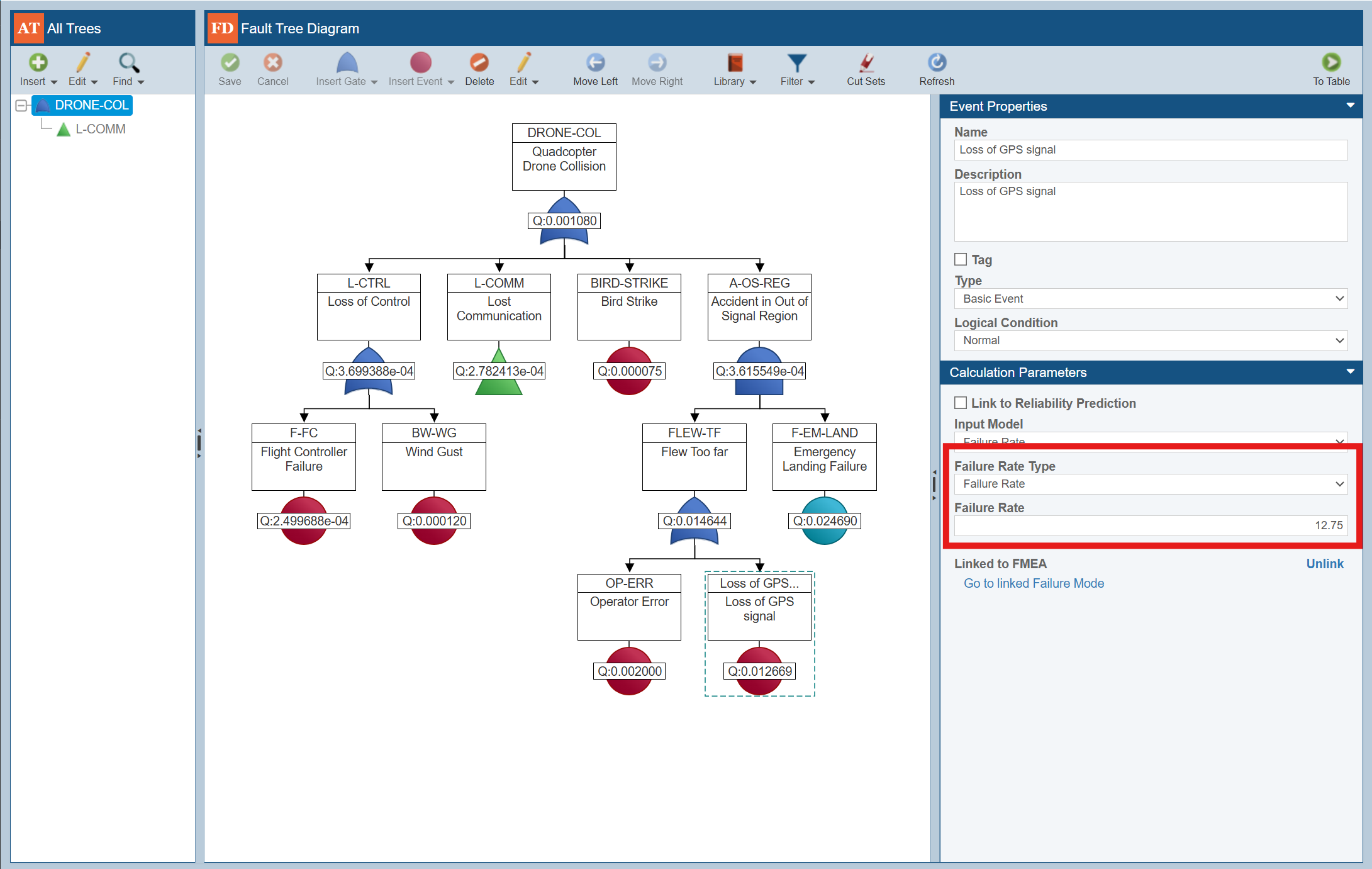
The Relyence API can be used to fetch and update information about the gates and events in your Fault Tree Diagram.
Reliability Prediction
Empowering you to efficiently manage part information in Reliability Prediction within your Analyses, the Relyence API allows you to view, insert, update, and delete parts as needed, providing flexibility in maintaining your data. For organizations that frequently update part information from external sources, implementing a Relyence API solution to automate this process can improve efficiency. By automating part management, you can ensure that your Analyses are always current, saving time and reducing the risk of errors.
RBD
Implementing the Relyence API into RBD allows you to effortlessly fetch and update critical information related to your RBDs, guaranteeing that your calculations are always based on the most accurate real-world data. Additionally, you can send your most recent RBD results reports to where they are needed, ensuring an accurate decision-making process is followed for product improvement efforts.
Weibull and ALT
The Relyence API enables you to easily fetch information from your Weibull and ALT data sets. By leveraging this capability, your organization can ensure that you have the most accurate and up-to-date information integrated where these calculations are utilized.
How Do I Get Started Using the Relyence API?
Visit our comprehensive Getting Started with Relyence API page in the Relyence User Guide and out Relyence API Documentation to discover the full extent of the Relyence API. This valuable resource provides an in-depth overview to help you seamlessly integrate the Relyence API into your processes. Need personalized assistance? Our dedicated Relyence Support Team is here to help you tailor the API to fit your specific requirements.
Conclusion
At Relyence, our mission is to build not only the most capable tools, but also the most technologically advanced and well-crafted applications available. The Relyence API showcases the Relyence advantage: elegant, intuitive design backed up with reliability expertise that makes your job easier and allows you to focus on what matters most—driving innovation and delivering value.

Relyence offers a free fully functional trial of our complete tool suite! Check out Relyence API capabilities along with our complete reliability and quality software tool suite.