When most people think about reliability, they picture machines that keep running or products that stand the test of time. At a high level, this is indeed the case. However, by looking a little deeper, it becomes apparent that reliability failures don’t just stop a machine; they stop trust. Once trust breaks, rebuilding it costs far more than the price of any replacement part.
In today’s connected world where customers expect performance, safety, and value, reliability is far more than an engineering goal; it’s a fundamental part of a company’s brand, profitability, and long-term survival. In this article, we’ll explore what reliability really means, why it matters, and how organizations can build it in from the start.
What Reliability Really Means
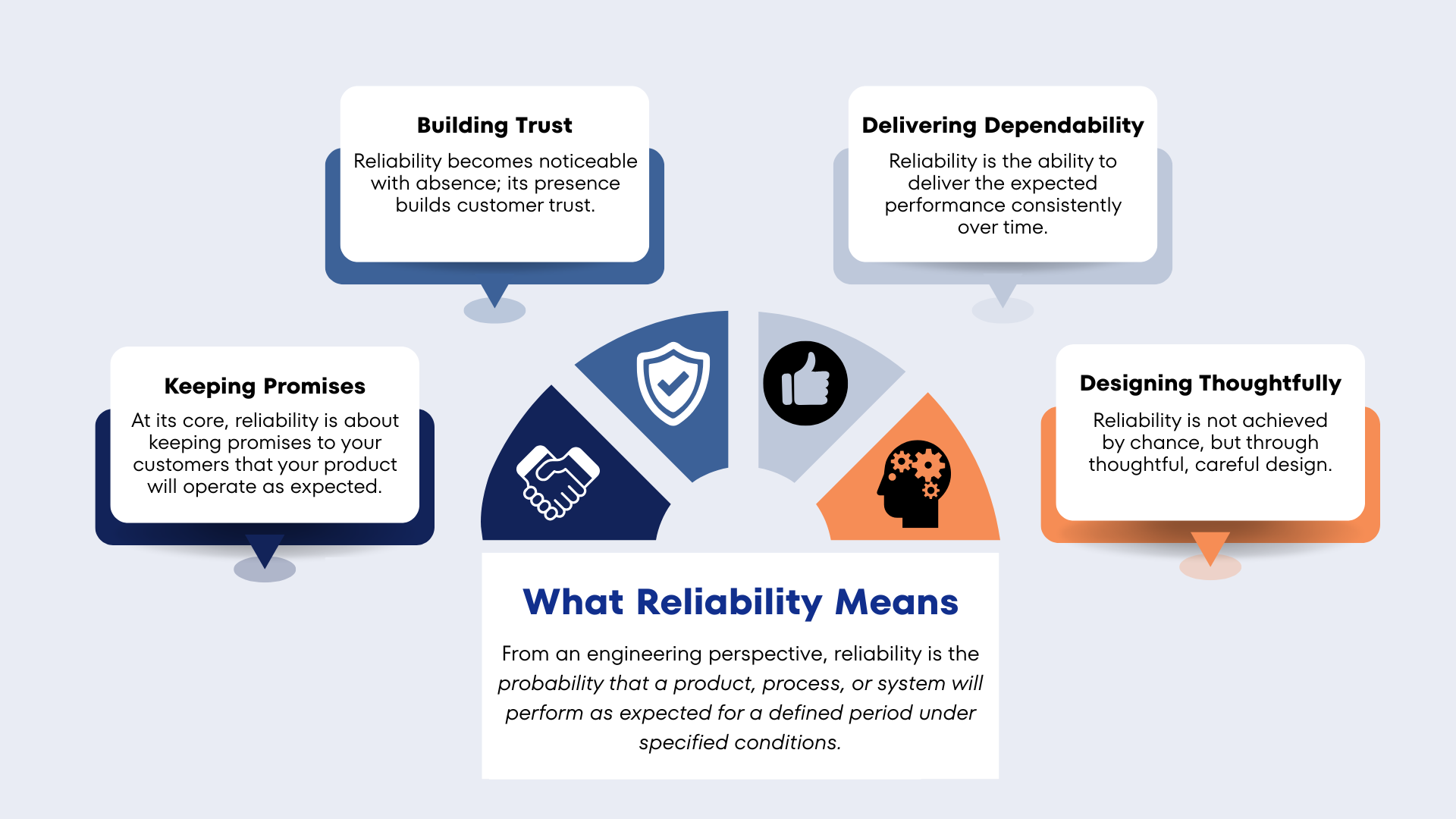
Reliability is defined in engineering terms as the probability that a product, process, or system will perform as expected for a defined period under specified conditions. That is the formal definition, but at its core, reliability means keeping promises. When a car starts every morning, when a medical device delivers accurate readings, or when a smartphone works flawlessly day after day—that’s reliability in action.
What makes reliability unique is that it is often invisible when present. Customers rarely stop to appreciate a product that simply works. Reliability becomes noticeable only in its absence: when a vehicle breaks down unexpectedly, a production line stops running, or a consumer product fails long before its expected life. In those moments, reliability stops being an engineering metric and becomes a direct measure of trust.
From an engineering perspective, reliability is never achieved by chance. It results from thoughtful design, careful material selection, robust manufacturing processes, thorough testing, and continuous learning from field performance. Organizations that prioritize reliability seek to identify potential failures before customers ever encounter them by designing for real-world conditions, anticipating how products will age and wear, and making deliberate decisions to reduce risk across the entire product lifecycle. Ultimately, reliability is the ability to deliver the expected performance not just once, but consistently over time.
Why Reliability Matters More Than Ever
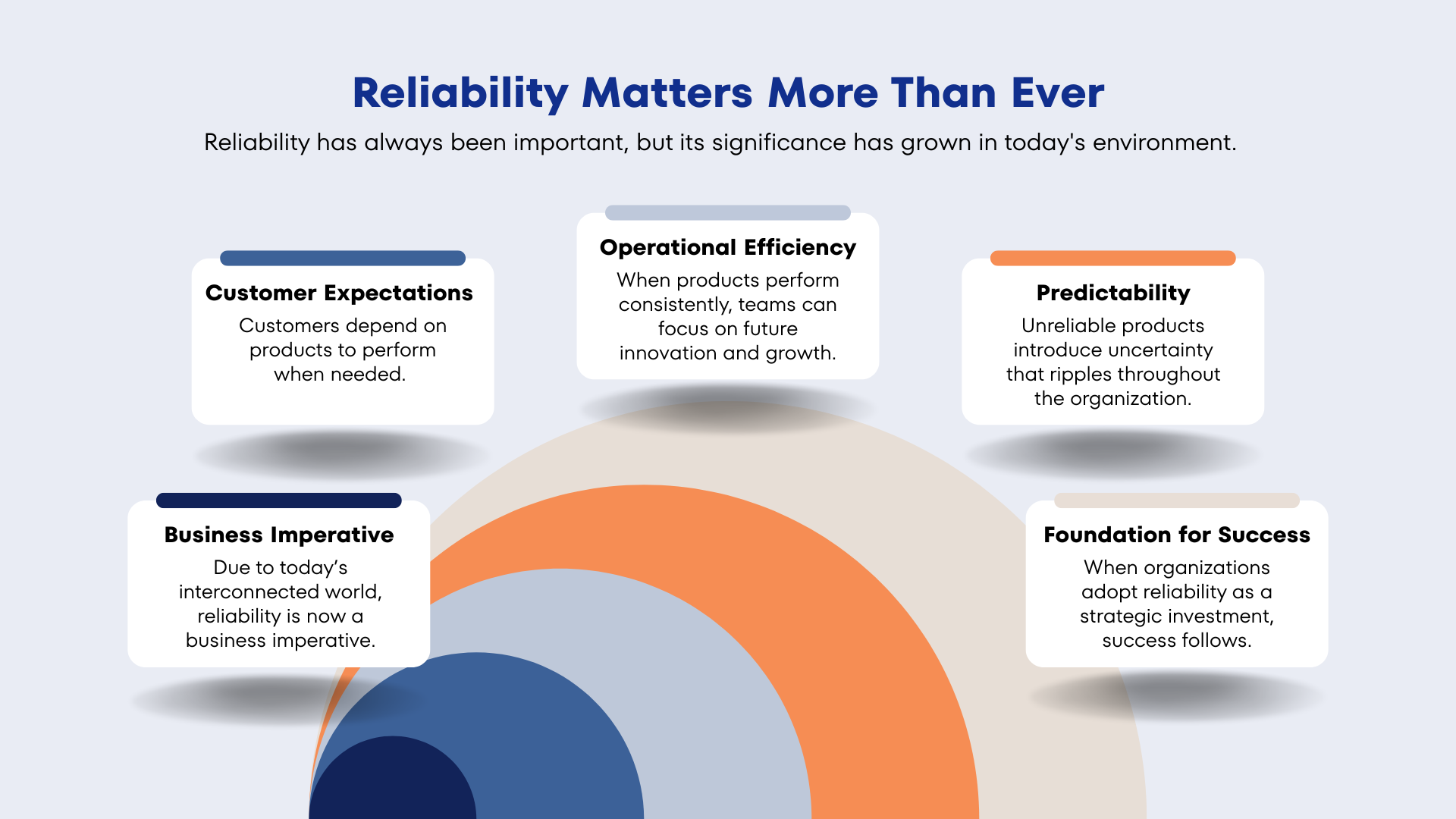
Reliability has always been important, but its significance has grown considerably in today’s environment. Products are more complex, supply chains are more interconnected, and customer expectations are higher than ever. A single failure can become visible to thousands of people almost instantly through online reviews, social media, and news coverage. Reliability is no longer just an engineering concern; it is a business imperative.
At its most basic level, reliability matters because people depend on products to perform when needed. Whether it’s a family relying on a vehicle to safely transport their children, a hospital depending on life-saving equipment, or a manufacturer running a production line around the clock, users expect products to work as intended. When those expectations are met consistently, confidence grows. When they are not, the consequences can range from inconvenience to significant financial losses, and, in critical applications, risks to human safety.
For organizations, the business case is equally compelling. All the investment a company makes in product development, manufacturing, marketing, and customer retention can be undermined when products fail prematurely. Warranty costs, recalls, field service expenses, and emergency repairs quickly consume profits. Worse, dissatisfied customers rarely return, and engineers find themselves fixing yesterday’s problems instead of developing tomorrow’s solutions. Reliability, in this sense, is also an efficiency issue: organizations whose products perform consistently can focus their resources on innovation and growth rather than damage control.
Reliability also creates the predictability that sound business decisions require. Customers, operators, and leaders all plan based on expectations of future performance. Reliable products make it possible to schedule maintenance, forecast costs, manage inventory, and allocate resources with confidence. Unreliable products introduce uncertainty that ripples across the entire organization.
In many ways, reliability is the foundation on which every other business objective rests. Quality, safety, customer satisfaction, and profitability all depend on products performing consistently as expected over time. Organizations that treat reliability as a strategic investment can earn lasting customer trust, build stronger brands, and gain a sustainable competitive advantage.
Understanding the Cost of Product Failures
When a failure occurs, the initial costs are usually easy to measure: repairs, replacements, service calls, or warranty claims. But those are only the tip of the iceberg. The real costs go much deeper, affecting reputation, efficiency, and future revenue.
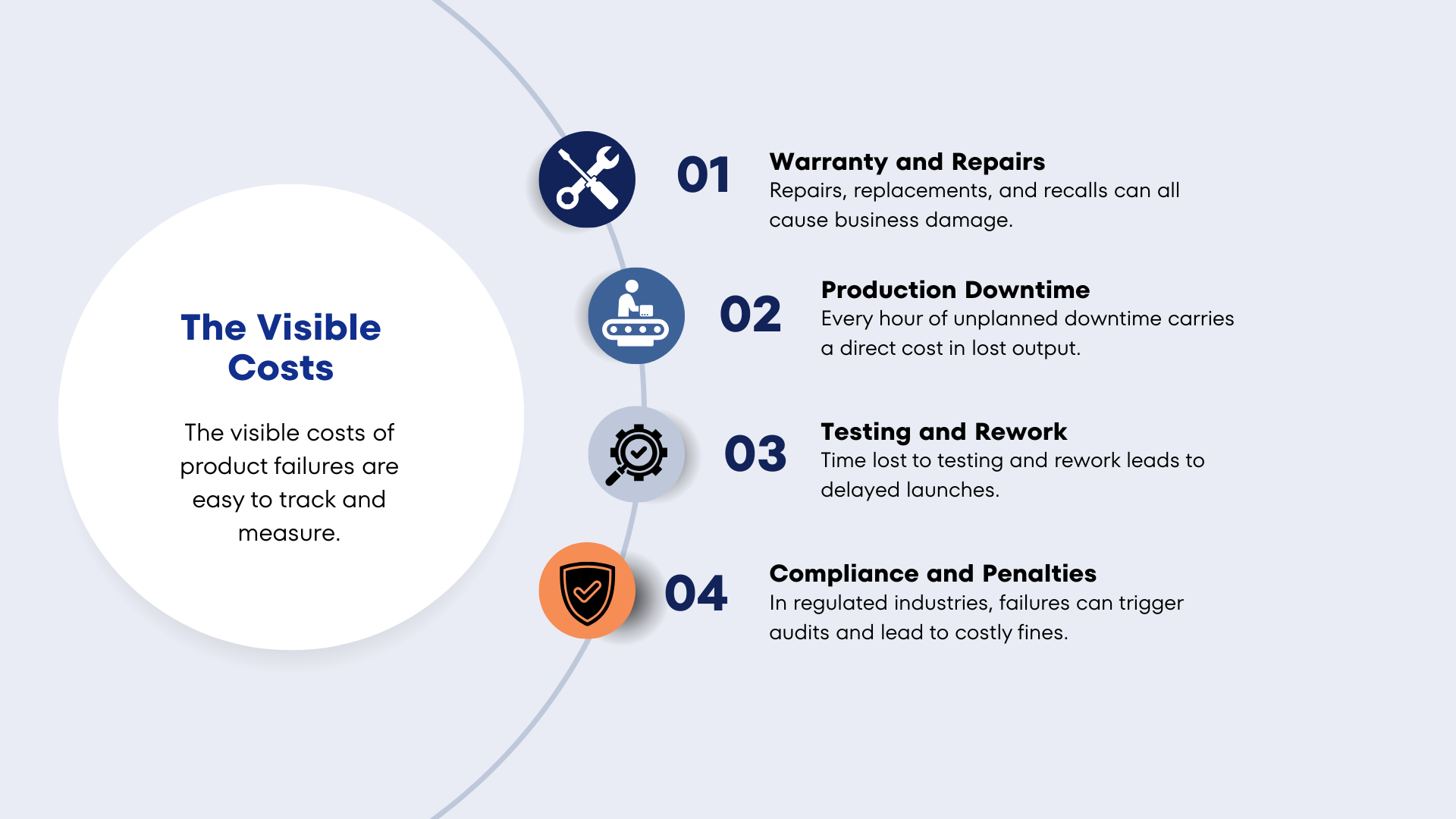
The Visible Costs
Visible costs of failure are the ones that are trackable and measurable:
- Warranty and Repairs: Repairs and replacements can be very costly, and, in the case of recalls, can cause major business damage. These costs can arrive suddenly and are difficult to budget for in advance.
- Production Downtime: A single component failure can halt an entire manufacturing line or ground a fleet. Every hour of unplanned downtime carries a direct cost in lost output and missed commitments.
- Testing and Rework: When a failure occurs, engineers must stop what they’re doing, diagnose the root cause, redesign the affected part or process, and revalidate. That lost time adds up to delayed product launches and loss of opportunity for new product development.
- Compliance and Penalties: In regulated industries like automotive, aerospace, and medical devices, a reliability lapse can trigger audits, mandatory reporting, or regulatory fines. In serious cases, it can result in production holds or product market withdrawals.
While these costs can hurt substantially, they have one advantage: they can be measured, tracked, and used to build the business case for investing in reliability up front.
The Hidden Costs
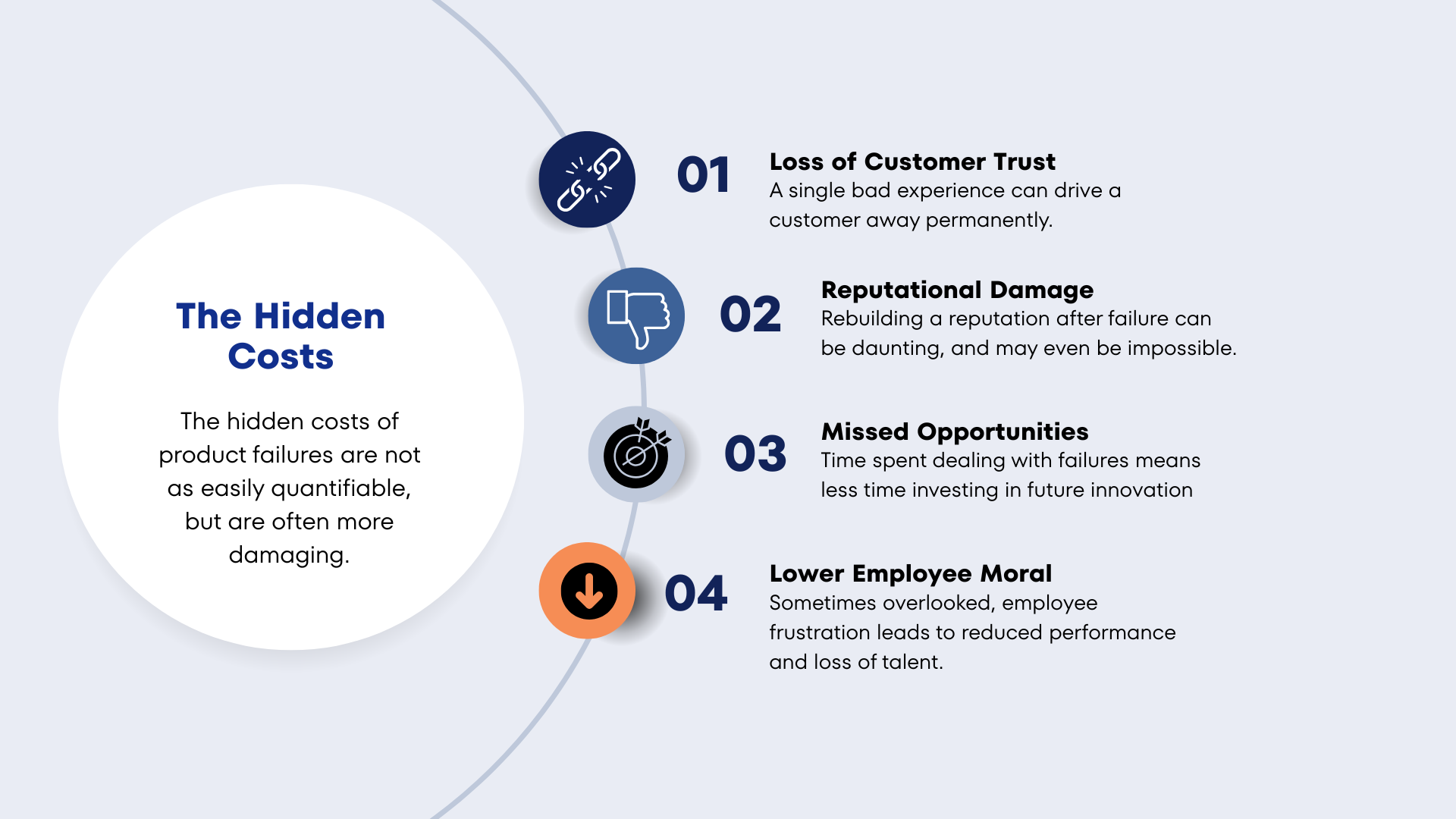
The hidden costs of product failures are harder to quantify but are often far more damaging than the visible costs. They accumulate quietly, eroding a company’s position until the damage becomes impossible to ignore.
- Loss of Customer Trust: A single bad experience can drive a customer away permanently. Lost trust shows up in loss of renewals and referrals and the slow erosion of market share over time.
- Reputational Damage: In an era of online reviews and social media, high-profile failures are shared across a wide network. Rebuilding a reputation after failure requires sustained effort and investment, and some companies never fully recover.
- Missed Opportunities: Every hour spent diagnosing a field failure is an hour not spent on the next product generation. Every dollar diverted to emergency repairs is a dollar not invested in innovation. The compounding effect of chronic reliability problems is an organization that perpetually fights fires instead of building its future.
- Lower Employee Morale: Beyond the external consequences, the impact of repeated failures on the people inside a company is easy to overlook. Engineers who take pride in their work are demoralized when products fail in the field. Over time, that frustration leads to disengagement, reduced performance, and the loss of experienced employees who are difficult and expensive to replace.
Hidden costs are difficult to quantify, which is why they pose a real threat to business success. They can accumulate unchecked until the damage is done. As one industry adage puts it: If you think reliability is expensive, try failure.
How to Ensure Product Reliability
The most effective organizations build reliability in from day one. That means designing for durability, testing for real-world conditions, and maintaining a continuous improvement loop throughout the product lifecycle. While every industry and product type has its own requirements, top-performing reliability programs tend to share a common set of practices.
#1: Prevent Failures Before They Occur
The earlier a potential failure is identified, the cheaper and easier it is to address. Structured risk analysis during the design phase enables teams to identify high-risk failures and eliminate them before production even starts. In this early stage of the product lifecycle, a design change is easy to make. If a failure occurs once a product is in the field, the costs escalate quickly. The root cause must be investigated and an action plan to prevent reoccurrence must be implemented. Costs may include product redesign, changes in the manufacturing process, product recalls and retooling, and more. This is why the most effective organizations invest in reliability from the start.
#2: Predict Performance and Design-in Reliability
Rather than waiting to see how a product performs in the field, leading organizations use quantitative analysis to predict reliability before products are built and shipped. Techniques like Reliability Prediction analysis, Weibull analysis, and Reliability Block Diagram (RBD) modeling allow engineers to define measurable targets, compare design alternatives, and make data-driven decisions about where to invest design effort, enabling engineers to design-in reliability.
#3: Track Failures and Close the Loop
Even well-designed products encounter failures during testing or in the field. A disciplined failure reporting and corrective action process ensures that every incident is captured, investigated, and resolved, and verifies that the problem is fixed before the issue is closed. Implementing a cohesive Corrective and Preventive Action (CAPA) process means your failure process is well-managed and controlled. Organizations that follow a structured approach to failure analysis and corrective action can prevent recurring failures by identifying and eliminating root causes. In contrast, organizations that simply react to problems as they occur often find themselves addressing the same issues repeatedly.
#4: Manage Risk at the System Level
Individual component reliability is only part of the picture. Risk analysis, such as fault tree analysis, allows teams to model how failures propagate through a system, identify combinations of events that could cause critical outcomes, and prioritize risk reduction efforts where they matter most. Understanding how individual component failures interact at the system level is often where the most critical risks are uncovered.
#5: Optimize Maintenance and Repair Strategies
For products in service, reliability is also shaped by how well they can be maintained. Designing for maintainability by minimizing repair times, simplifying access, and establishing smart preventive maintenance schedules, reduces downtime and extends useful life. In high-uptime environments, a well-designed maintenance strategy can be as valuable as the original design itself.
#6: Build a Reliability Culture
Processes and tools matter, but people matter more. The most reliable organizations treat reliability as everyone’s responsibility, from design engineers to manufacturing teams to customer service. Business leaders need to make sure all members of the team understand the importance of reliability to the business itself. This helps team members understand their role in ensuring the company’s success through a commitment to reliability.
How Relyence Helps Assure Product Reliability
At Relyence, we’ve seen how quickly organizations transform when they move from reactive problem-solving to proactive reliability management. What makes that shift possible is having the right tools and having them work together. Our integrated platform, Relyence Studio, brings all the essential reliability disciplines into a single environment so teams can collaborate, share data, and make confident decisions at every stage of the product lifecycle.
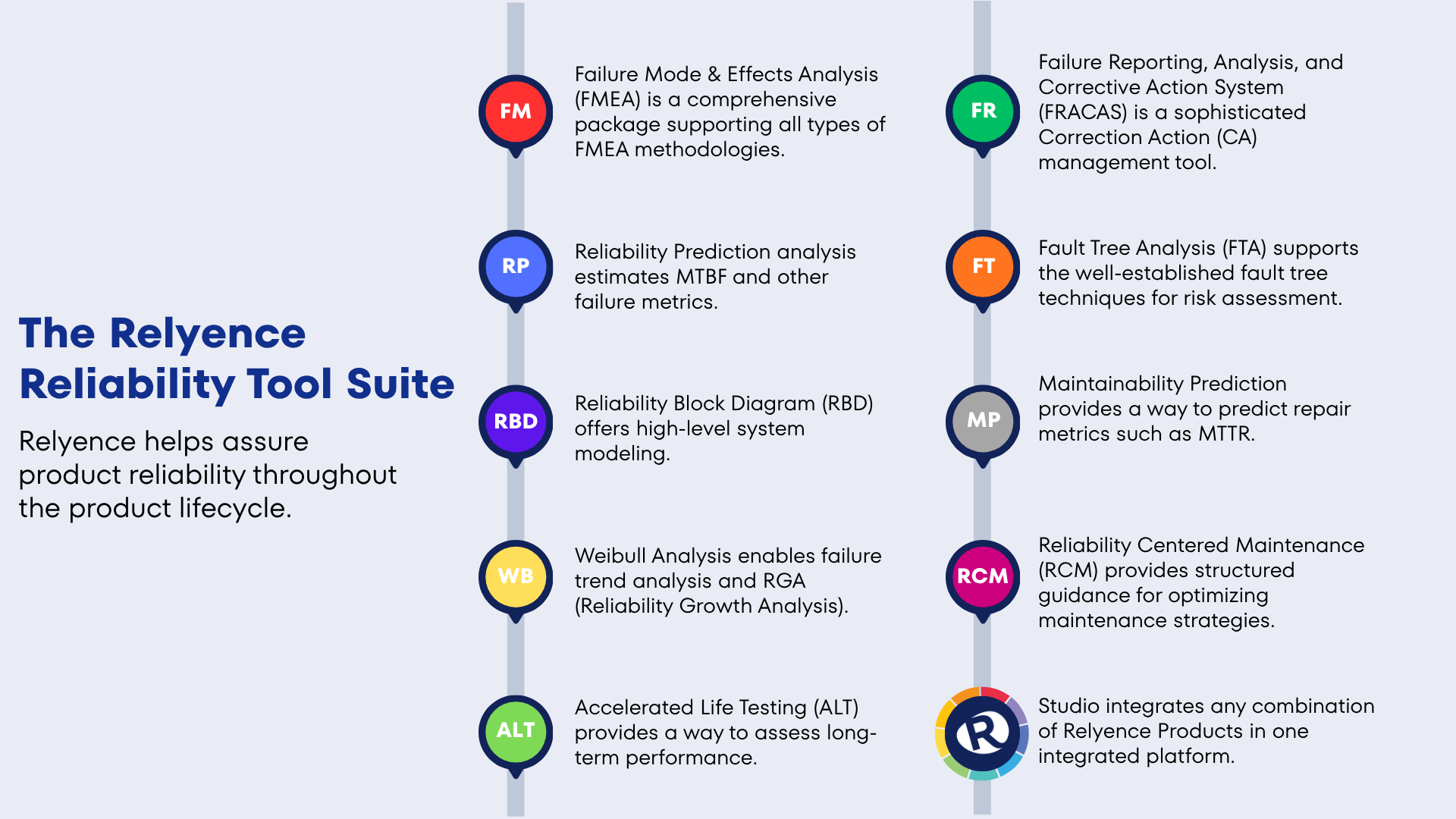
The Relyence Reliability Tool Suite
Relyence FMEA (Failure Mode and Effects Analysis) is a widely acclaimed tool for risk assessment encompassing all FMEA components: Worksheets, Boundary Diagrams, Parameter Diagrams, Process Flow Diagrams, Control Plans, DVP&R (Design Verification Plan and Report), and Function and Failure Nets. As one of the commonly used reliability analysis tools, FMEA provides a structured approach for evaluating potential failure modes, identifying the resulting effects of those failures, and then using risk scoring to help target the most critical failures for elimination or mitigation. Supporting a broad range of FMEA types, as well as leading industry standards, Relyence FMEA is known for powerful capabilities and extensive customization capabilities.
Relyence Reliability Prediction, RBD, Weibull, and ALT provide a quantitative backbone for designing in reliability. Relyence Reliability Prediction analysis enables engineers to compute MTBF (Mean Time Between Failure) of electromechanical systems to make sure reliability targets are met. Relyence RBD (Reliability Block Diagram) pairs visual system modeling with sophisticated mathematical techniques, such as Monte Carlo simulation, to compute a range of performance metrics. Relyence Weibull evaluates failure trends and includes RGA (Reliability Growth Analysis) capabilities. Relyence ALT (Accelerated Life Testing) enables engineers to determine long-term performance of products with a long lifespan.
Relyence FRACAS (Failure Reporting, Analysis, and Corrective Action System) provides a comprehensive, organized approach for tracking and managing issues. Supporting well-accepted process methodologies such as 8D and DMAIC, Relyence FRACAS is a highly customizable closed-loop system for failure management.
Relyence Fault Tree supports risk assessment based on fault tree techniques. It enables teams to model complex system risks visually, identifying the combinations of events and conditions that could lead to critical failures, and quantifying the probability of those outcomes so resources can be focused where they’ll have the greatest impact.
Relyence Maintainability Prediction and Relyence RCM (Reliability Centered Maintenance) help organizations optimize maintenance and repair activities by assessing metrics such as MTTR (Mean Time to Repair) and identifying strategies that best balance uptime, cost, and risk.
All of these tools share a common data environment within Relyence Studio, so information flows freely across analyses. Everyone works from the same data, reducing errors and keeping the entire organization aligned.
Final Thoughts: An Investment in Reliability Means Long-Term Success
Reliability represents a promise between a company and its customers. It says, “You can depend on us.” When that promise is kept, trust grows, brands strengthen, and business thrives. When it’s broken, even once, the consequences can echo for years.
The most successful organizations don’t wait for failures to happen and then react. They invest in reliability early and continuously, knowing it pays off in customer loyalty, lower costs, and long-term success.